by Julie Ann Claire Nedula Nique and Liz Drury O’Neill
Stories
The women of the Pulo Island Barangays- Concepcion, Iloilo, Region 6, Philippines
Hiligaynon terms are written in italics with their English translations in brackets, some terms are Filipino e.g. Barangay, Sitio.
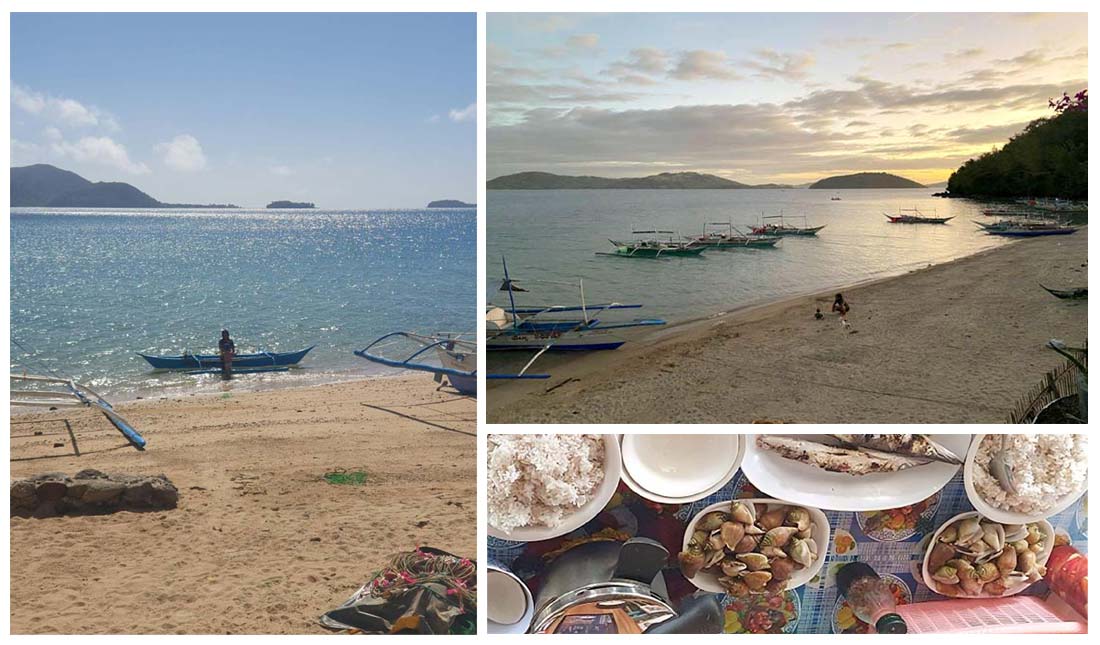
This short descriptive report comes from work during 2025 with the Patron of the seas project run by Liz Drury O’Neill from the Stockholm Resilience Centre and Professor Alicer Ferrer from the University of the Philippines Visayas with collaborators Therese Lindahl, Simon West, Jinky Hopanda, Julie Ann Claire Nique and Robert Pomeroy. Here we present data collected from 144 women (107 men) across 7 Sitios (akin to villages) in one island Barangay (the smallest political unit in the Phillipines) in Concepcion, Iloilo as part of an experimental campaign in 2025 (to read more about the economic experiments see here). The premise of this short report is to present the marine resource using activities of the women who live in the pulo (Island Barangays) and a little background on their livelihoods - simply to make them visible as fisherwomen in this locality. We end by reporting on changes and disturbances to their fishing activities and subsequent responses.
| Demographic variables describing fisherwomen | |
| Age | 45.5 years (Oldest: 80, youngest 18) |
| Households | On average 2 kids per household (1,3 SD) and 3 adults (1,5 SD) |
| Formal education level | 44% of women have up till high school, 35% have up to elementary school, 15% are college/university educated while the remaining few have varying levels of junior-senior high school education as well as technical certificates |
| Native/migrant to sitio | 63% of participants were born in the sitio while the rest came from either other sitios within the same barangay or further afield e.g. Carles, Estancia, Negros Oriental and Cebu. |
| Years in fishing | 22 years (standard deviation 16 years) |
| Fishery related activities (n) | Gleaning (126) Fishing on vessels- finfish (58) Crab fishing on vessel (20) Processing dried fish (39) Selling/trading dried fish (20) Seaweed business (13) Crab picking (5) Selling/trading fresh products (4) Net making (2) |
The study sampled a wide range of fishing activities which were classified into (1) Male Pumpboat Users, (2) Male Baroto (small non-mechanised canoe) Users, and (3) Female Gleaners and Vessel Users (we will refer to them as fisherwomen in this report though this is not how they might/may identify). For this report we focus on the latter category who are typically overlooked as fishers both in the locality and at the national level (e.g. see Torrel et al 2021). Table 1 presents some demographic and livelihood information on the women we worked with during the experimental campaign of 2025.
Gleaning Activities
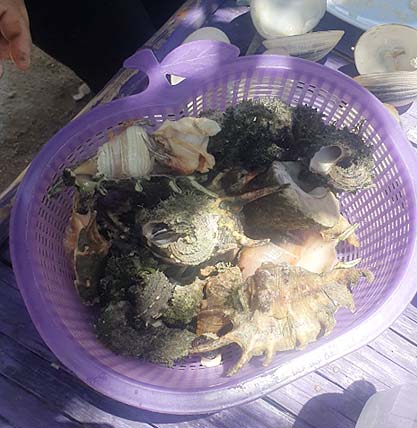
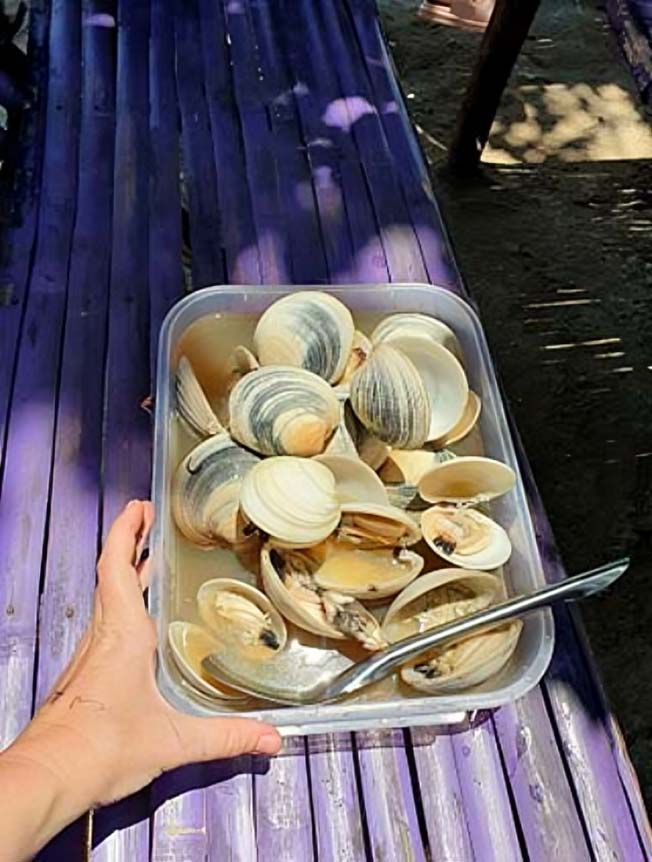
Gleaning, locally known as panginhas (or pagpanginhas more specifically as the verb or action), is one of the fishery activities practiced by the barangay residents and particularly this female marine resourcing using group (126 women - though men also partake, 49 out of 107 men in our sample regularly gleaned). It is typically done in shallow coastal areas and zones exposed during spring tides, which happen twice a month, especially when the sea is calm and the weather is good. Most of the time, the fisherwomen harvest with others---usually their children, friends, relatives, and neighbors. Their catch primarily consists of various species of mollusks (both bivalves and gastropods), which can easily be picked up by hand once some parts of the shoreline are exposed (See Table 2 for an overview of the species the fisherwomen extract through gleaning). However, some species require sharp eyes, or as it's called in Concepcion “ginamata-mata”, to spot them hidden among the sand. Others, such as sikad (Strombus canarium), saang (Lambis lambis), and botlog (Turbo spp.), need simple tools, like pisaw (a small knife) and sundang (a wooden tool with a sharp edge), to aid in digging and extracting these invertebrates from the sand and rocks. Some gleaners use only locally available materials, such as paya (a coconut shell) cut in half, as an alternative to sungkit (scoop) and kaykay (scrape) to dig through the substrate in search of buried pakinhason (the output of gleaning) like kagaykay (Meterix spp.) and punaw (Marcia hiantina). Some of these pakinhason are now rarely seen near the shore and require freediving to collect them, as in the case of wasay-wasay (black hammer oyster). Gleaning may commonly occur during the day, but it can also take place at night with the aid of flashlights, a practice known as panulo. During panulo, dawat (a crenate swimming crab Thallamita crenata) is usually targeted, along with other shell species mentioned earlier.
Post-Harvest
Harvests are commonly stored in balde (pails), tabo (dippers), or recycled containers of various sizes, including those used for paints and biscuits. Most of the gathered gleaned products are for consumption at home, especially when the weather is poor (>51% of those who could estimate average kilos of pakinhason n=95). However, when they have a good harvest, the excess is sold around the barangay or the mainland to a suki (regular customer - a patron or buyer they have a personalized economic relationship with) or to anyone interested in buying them. Although the majority of our experimental participants (n=251) experienced sukianay (patron-client relationships) it is more common for men to have a suki - 92% of men vs 76% of women. Some gleaners establish sukis through the other products they process, such as dried fish and seaweeds. Others treat their husbands’ sukis as their own, such as the brokers, buyers in the mainland and barangay, and the crab plant. Additionally, some pakinhason is given away to neighbors and relatives or bartered for other goods, like vegetables, fruits, and rice. An average normal gleaning harvest is reported as 3-4 KG (SD=5 KG) and when sold a normal income is about 210 PHP/3.7 USD (SD= 190 PHP).
One of the reasons why gleaners typically have no suki for their pakinhason is due to the unavailability of these resources, driven by natural and human-induced factors. Harvests are increasingly low, which makes commitments to a regular buyer or suki difficult because there is no guarantee that they can immediately deliver products. Additionally gleaners emphasized that there is a poor market for these commodities and shared that buyers prefer fish over gleaned species. Besides, most people on the island are gleaning, too. Hence, a high demand in the market or having a permanent suki in the island is likely a rare thing to happen.
| Species (Hiligaynon, English, Scientific Name) |
Gear Used Hiligaynon , (English) |
| Taktakon/Tatak/Tatak, Girgylus star shell, Bolma girgyllus | Sundang ( wooden dagger), Pisaw (small knife) |
| Saang, Spider Conch, Lambis lambis | Pisaw (small knife) |
| Litob, Inequivalve Ark, Scapharca inaequivalvis | Pisaw (small knife), Paya (Coconut Shell) |
| Sikad, Dog Conch, Strombus canarium | Pisaw (small knife) |
| Supsup dalaga/Samong, Smooth top shell, Rochia nilotica | None/by-hand |
| Pungsuran, Lacinate Dolphin Shell, Angaria delphinus | Pisaw (small knife) |
| Botlog, Turban shells, Turbo spp. | Sundang (wooden dagger), Pisaw (small knife) |
| Kagaykay, Hard clam, Meretrix spp. | Paya (Coconut Shell) |
| Wasay-wasay, Black hammer oyster, Malleus malleus | Pisaw (small knife) |
| Kalam-isan/Talam-isan, Youthful venus, Periglypta puerpera | Pisaw (small knife) |
| Punaw, Hiant venus, Marcia hiantina | Paya (Coconut Shell) |
| Bug-atan, Tumid Venus, Gafrarium tumidum | Sundang (wooden dagger), Pisaw (small knife) |
| Dawat, Crenate Swimming Crab, Thallamita crenata | None/by-hand |
| Giti-giti, a local name for several bivalve cockles | Pisaw (small knife)/td> |
| Tuwad-langit, a local name for a type of sea snail | None/by-hand |
| Takab-takab, Scallop, Pecten spp. | None/by-hand |
| Suli-ot, Ventricose ark, Arca ventricosa | None/by-hand |
| Layagan, Bat volute, Cymbiola vespertilio | None/by-hand |
| Taklap-taklap, no translation | None/by-hand |
| Kulukalaha, no translation | None/by-hand |
| Ingkoy-ingkoy, no translation | Sharp wood stick |
| Tipay-tipay, Pearl oyster, Pinctada spp. | None/by-hand |
| Pasayan, Shrimp, Penaeidae spp. | Puyo-puyo (A shrimp trap made from nettings with circular wire) |
| Apugan, Cone Shell, Conus spp. | None/by-hand |
| Balisaha, Clam | Sundang (wooden dagger) |
Boat Fishing Activities
Aside from gleaning, these women also fish on vessels (45%) either as crew for pumpboats (mechanized vessels) or using baroto - the majority of them are owners of their baroto vessels. A large portion of the fisherwomen go out fishing as crew (71% of boat users) with their husbands and children, especially when the sea is calm or the weather is good. Sometimes (15 women) they can be captains of their baroto, which is commonly observed among the gleaners who have lived and been born on the islands. When using baroto they fish with pangawil (Squid jigger) and taga (Hook and Line) to catch lukos (Loligo spp.) and most commonly lagaw (Nemipterus spp.) and opusan (Scolopsis taenioptera), sometimes asuos (Sillago spp.), pugaro (Epinephelus lanceolatus) or latab (Gerres spp.). If working on pumpboats they typically use lambat (net) of different types e.g. panumbok (a type of gill net) or pangasag (crab gill net) and land asuos, alatan (Plectorhinchus spp.) or kasag (Portunus pelagicus). On average when fishing with vessels the fisherwomen land 8.2 KG (SD= 13 KG) sometimes as little as 1 KG or a maximum of 80 KG when fishing small-pelagics with a Likos (encircling gill net)). A normal daily income from boat fishing is about 1000 PHP/17 USD (as of April 2025) (SD= 1273 PHP), above average incomes typically come from panumbok, palubog (bottom set gill net) and taga for asuos and lagaw (either baroto or pumpboat).
Household Economics
The main income generating activity for these ladies' households is boat fishing/fishing with vessels, gleaning, the dried fish uga processing business, seaweed farming and other types of petty trade or small business ((i.e. tiangge (assorted) stores or selling food outside the school). Their households also earn from other jobs such as healthcare work in the barangay, daycare teachers, remittances tutors, occasional labour and through agriculture. On average the households have 3 income sources (SD= 1.5) with typically only 1 being from a non-fishery source. Participants estimated their monthly income from the different jobs that support their households and on average households took in just over 9500 PHP per month (SD= 7900 PHP) which is about 169 USD (as of April 2025). 61 out of the 144 fisherwomen households hadn’t been able to put away any savings the month before the survey, while those who could save put away on average 1491 PHP/ 26 USD (SD= 2860 PHP).
Changes, Disturbances & Adaptation
The women participants were asked about the changes to their catches and their environment, and what this might mean for them. Almost 60% of the participants feel they land poor catches at least a few times a week or several times a month. The most frequently cited reason for poor catches is bad weather conditions (madlos), often described as gloomy, rough seas, or generally unfavorable weather, including the presence of typhoons (Bagyo) or rain (Ulan). Poor landings are also attributed to hot weather (init, Tam-an ka init), which is severe enough to cause fish to swim out to deeper waters. Many women indicate that the absence of a low tide (at the right time) or the presence of high tide and bigger waves leads to poor catches. Participants also mention that now there can be too many people gleaning (damo na gapanginhas). Commercial or large fishing nets (sinsoro) are harvesting juvenile fish (lupoy), meaning small fish are taken continuously, and this illegal fishing disturbs the area. Finally we asked them how they would respond if their landings halved, to which they would employ a range of strategies driven by economic necessity, resource management, and livelihood diversification. A major response is to continue fishing or gleaning (padayunon ang pagpanginhas), often described as having no choice. Many state that this activity is their only source of income, their only livelihood, and their only source of daily needs. If they stop, they will have nothing to eat or spend. Therefore, they must continue to endure poor catches (tiyagan lang bisan pigado) just to earn some income. Some express hope, continuing to fish (sigehon lang Hook and line) or glean while taking a chance that they may still collect something. To compensate for the reduced catch, many fisherwomen plan to seek other sources of income, often shifting their focus inland (sa takas) e.g. farming, planting vegetables, cassava, small businesses or pursuing service-based jobs e.g. laborer, laundry, making charcoal, sewing. Several individuals plan to actively manage the marine resources to encourage recovery or sustain future catches by allowing the fishing or gleaning species to rest/grow or selectively harvesting only the larger individuals. The women would also adjust where and how they fish, i.e. changing locations, fishing in the more open ocean, and switching species. Some believe they must rely on government policies, urging the protection of Marine Protected Areas (MPA) and seeking support from local and national government units (LGU, BFAR, NFARMCs). They stress the need to enforce regulations to stop illegal fishing methods (like sinsoro or dynamite fishing) and prohibit the use of nets that catch small or juvenile fish, as these activities negatively affect small-scale fishers.
Authors
- Julie Ann Claire Nedula Nique is affiliated with the Patron of the Seas project as a Research Assistant at the University of the Philippines Visayas Foundation Inc. She is a fisheries professional interested in research on small-scale fisheries and aquaculture.
- Liz Drury O’Neill is a researcher with Stockholm Resilience Center, Stockholm University in Sweden and Primary Investigator of the project Patron of the Seas from which this piece comes. She is a marine social scientist with an interest in seafood trade, fishery markets, relational approaches, trans disciplinarity and more!
Related Material
See our article on gleaning (or foot fisheries) in Discover GAF
https://www.genderaquafish.org/gleaning.htm